
While some people can manage the condition with lifestyle modifications, medication, or surgical intervention, for those with severe, end-stage HF, a heart transplant remains the gold standard treatment. Yet only approximately 7,000 of these procedures are performed globally each year due to limited donor availability, leaving a significant proportion of patients without viable long-term options.3
Mechanical circulatory support devices, including ventricular assist devices and Total Artificial Hearts (TAH), provide short-term bridge-to-transplant support. However, existing TAH technologies have limitations: they rely on complex pump designs with multiple moving parts, flexible diaphragms, and external pneumatic drivers, which contribute to device wear, blood clots, stroke risk, and reduced patient comfort. Current systems are approved only for short-term use, highlighting a major gap for patients who require longer-term circulatory support or are ineligible for transplantation.
A novel approach to artificial heart technology
BiVACOR, an Australian-born medical device company headquartered in California, with offices in Houston, Texas, and the Gold Coast, Queensland, is developing a next-generation TAH designed to overcome these limitations.
Unlike conventional volume displacement TAHs, the BiVACOR TAH features a magnetically levitated dual-sided centrifugal impellar engineered to provide durable, reliable support without many of the complications associated with conventional devices. Made from biocompatible titanium, it contains a single moving part, no valves, and large blood-flow gaps – features that significantly reduce the risk of clot formation and mechanical failure.
With the potential to deliver long‑term, destination therapy, the BiVACOR technology represents a transformative opportunity for patients with end‑stage HF.
An external controller and batteries power the internal device via a percutaneous driveline that passes through the patient’s abdominal skin. While the initial controller was developed for short-term bridge-to-transplant use, realising the ultimate goal of developing a viable long-term alternative to heart transplantation requires a smaller, lighter, and more user‑friendly external controller suitable for everyday use.
TTRA enables the development of a long-term controller
In 2022, BiVACOR was awarded $750,000 through the Targeted Translation Research Accelerator (TTRA), along with support from TTRA Partner, the Medical Device Partnering Program (MDPP). Through the TTRA project, the company sought to redesign the external controller to accommodate long-term use in end-stage HF patients ineligible for heart transplantation.
TTRA support enabled BiVACOR to accelerate the hardware and software development of the long-term controller in parallel with the clinical evaluation of the short-term system. Achievements included improved reliability of the BiVACOR controller hardware and software; modified clinician/patient interfaces to better meet user needs; and optimised settings to improve patient monitoring. The upgraded controller was manufactured and tested against relevant medical device standards for longer-term use.
BiVACOR Founder and CTO Dr Daniel Timms said usability and portability are essential features of the external controller to enable long-term use of the TAH.
“The patient is going to walk around carrying this controller, so it needs to be not only reliable, but also user-friendly in how they can interact with it. It also needs to be small and light. The TTRA funding has helped us reduce the size and weight of the controller, so that when the patient has their artificial heart implanted, they also feel comfortable carrying the controller that drives it. When we started, the controller was about the size of a large textbook but with the TTRA funding we were able to decrease that to about the size of a book,” said Dr Timms.
BiVACOR Systems Engineer Chris Slade emphasised that the TTRA project enabled the team to achieve a major milestone on its journey to address the global unmet need of patients with end-stage HF.
“As an engineer, seeing our TTRA project culminate in a Total Artificial Heart controller designed for long-term use is a monumental achievement,” said Mr Slade.
“This technology empowers patients to lead fuller lives, fosters independence, and enhances their quality of life. This TTRA project has been instrumental in driving our research and development, providing the resources needed to innovate and refine our design,” he said.
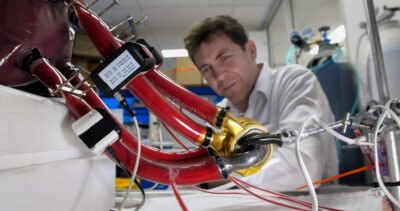
BiVACOR Total-Artificial Heart Blood Loop Test with Founder Dr Daniel-Timms
A viable bridge and destination therapy for end-stage heart failure
The benefits of a commercially viable, long-term mechanical replacement for the failing human heart has the potential to transform care for people with advanced HF.
Currently, the wait time for a suitable donor heart for patients requiring transplantation can vary from days to months – even years. The availability of a long-term TAH could offer life-saving circulatory support for patients waiting for a transplant while improving quality of life or ultimately serving as a practical alternative to heart transplantation itself.
From an economic perspective, uptake of the BiVACOR TAH as a bridge-to-transplant alone could ease the financial burden of HF on hospitals. Terminal or waiting-list patients who would previously have stayed in the ICU – at a cost of over $5,000/day in Australia4 – could be relocated to more cost-effective general wards or even return home.
The TTRA-supported controller is a critical component in enabling BiVACOR’s device to transition from short-term to long-term and, ultimately, to be used as a viable alternative to donor heart transplantation and sustainable solution to heart failure.
Strengthening local partnerships and future commercial pathways
The TTRA project also gave BiVACOR the opportunity to develop and strengthen working relationships with Australian companies that focus on manufacturing and software design. The team hopes to maintain these relationships for future system development and to eventually bring the technology to market locally.
Looking ahead, BiVACOR aims to reach as many advanced HF patients as possible with its innovative device, and the development of the long-term controller during the TTRA project marked an important step towards meeting this goal.
As of 31 December 2025, the BiVACOR TAH has begun first-in-human trials in the US as part of an FDA Early Feasibility Study and clinical studies in Australia as a bridge-to-transplant. The first Australian patient to have the implantation was also the first to be discharged from hospital, living in the community with their TAH for 105 days before receiving their donor heart transplant.
Dr Timms explained that, after the BiVACOR TAH implantation, patients recovered much faster than expected and were ready for their transplant surgery, for some in as little as five days.
“This device can effectively provide twice the amount of blood flow that any device created to date can manage to do. This enabled restoration of blood flow around the body very quickly to those organs that were struggling due to the heart failing. The organs recovered quickly and the patients were ready to withstand the next operation,” he said.
“Seeing the patients with our device get up out of bed and walk around, seeing their family members coming in with tears in their eyes, saying they haven’t seen that from them for years. This is what makes it all worthwhile,” Dr Timms said.
Representing a groundbreaking advancement in medical technology, BiVACOR’s TAH now has FDA Breakthrough Device Designation, recognising its significant potential to improve the quality of life for HF patients; this designation also highlights Australia’s leadership in next-generation technology and healthcare solutions. The progress made through the TTRA program has accelerated its pathway toward long‑term use and strengthened the foundation for future clinical and commercial advancement.
The company’s achievement underscores the nation’s commitment to fostering innovation that can make a profound difference on a global scale. With its successful development, BiVACOR’s device is poised to redefine long-term mechanical circulatory support, transforming the way we approach HF and offering hope and a brighter future for those in need.
1. Savarese, G. et al. (2023). Global burden of heart failure: a comprehensive and updated review of epidemiology. Cardiovascular research, 118(17), 3272–3287. https://doi.org/10.1093/cvr/cvac013
2. Australian Institute of Health and Welfare. (2025). Heart failure and cardiomyopathy. https://www.aihw.gov.au/reports/heart-stroke-vascular-diseases/hsvd-facts/contents/all-heart-stroke-and-vascular-disease/heart-failure-and-cardiomyopathy
3. El Rafei, A. et al. (2025). Review of the Global Activity of Heart Transplant. Circulation: Heart Failure, 18(7). https://doi.org/10.1161/CIRCHEARTFAILURE.124.01227
4. Carrandi, A. et al. (2024). Costs of Australian intensive care: A systematic review. Critical Care and Resuscitation, 26(2), 153-158. https://doi.org/10.1016/j.ccrj.2024.03.003