Globally, 338 million people live with blindness, or moderate to severe vision impairment[1], including 575,000 in Australia[2]. Beyond the economic burden – estimated at about US$411 billion each year in lost productivity[3] – vision impairment can significantly affect a person’s quality of life, limiting their ability to work, make and maintain social connections, study and carry out everyday tasks independently.
While many companies are exploring solutions such as bionic implants, usually aiming for restoration of eyesight as an end goal, New South Wales-based company ARIA Research is looking at the problem in a different light – by first listening to those who live with vision impairment.
Rather than chasing visual restoration, ARIA Research has collaborated closely with the blind community to understand their needs and co-develop a bionic solution that is practical, affordable and broadly applicable.
The result is an optical device that is non-invasive and requires no recovery time, provides functional benefit within minutes, and works for most individuals regardless of their underlying vision pathology.
Transforming images into sound
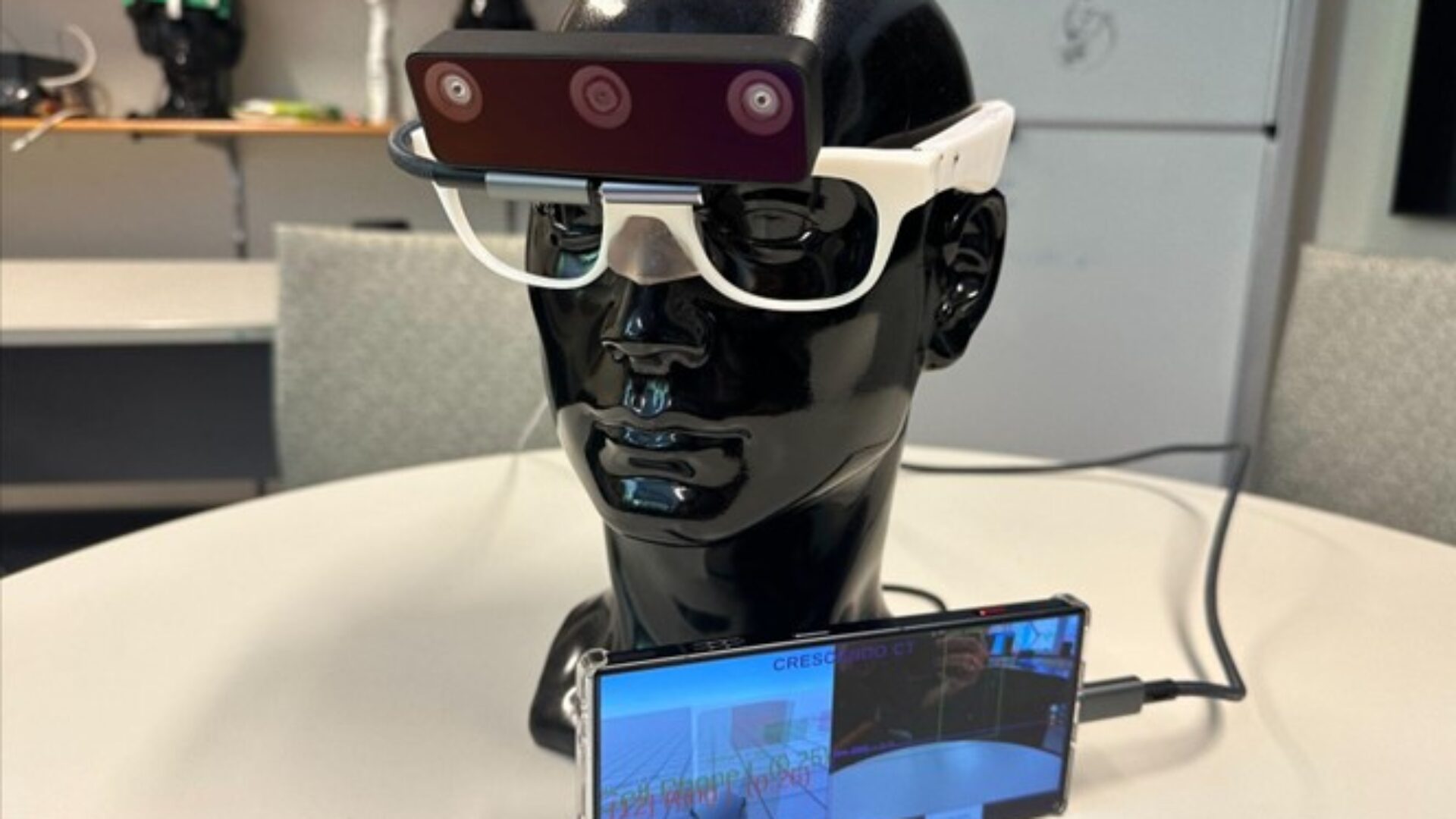
ARIA (Augmented Reality in Audio) is a non-invasive pair of glasses that leverages AI and machine vision to render the wearer’s environment as a real-time soundscape. The glasses can detect objects, obstacles, faces and more, and relay this information to the user via audio cues, allowing them to successfully navigate and interact with their surroundings. This enables blind users to have greater functional independence and, as a result, contributes to improved mental wellbeing.
The device was designed with scalability in mind, leveraging existing consumer electronics supply chains to deliver a low-cost, easily accessible solution to vision disability on a global scale.
Measuring what matters
In 2022, ARIA Research was awarded $1.5 million from the Clinical Translation and Commercialisation Medtech (CTCM) program, in addition to support and guidance from MTPConnect and the Medical Device Partnering Program (MDPP) as the program partner. This funding supported software development, prototype manufacture, preclinical validation and ultimately a pilot clinical trial.
The company encountered a unique challenge during this process: most existing outcome measures for competing bionic vision devices focused on visual improvements – metrics irrelevant to the ARIA’s sound-based technology. Additionally, the team found that existing measures on functional task performance for implanted bionics were too specific to the device and not representative of real-world conditions. So, they set out to “measure what matters” for blind users, devising test conditions that represented real world challenges faced by people living with blindness
This led to an extensive consultation and iterative co-design process, including “friendly” trials with blind stakeholders interacting with the ARIA prototype hardware to identify 12 tasks that represent common daily living activities that are either significantly challenging or impossible for individuals with vision impairments to complete. These identified tasks formed the foundation for the functional measures used during the pilot clinical trial.
“The process of co-designing the measures with the end user was a significant investment, and it bore fruit with measures and a protocol that has been road-tested and that we felt confident in,” said ARIA Research CEO and Co-Founder Robert Yearsley.
The pilot clinical trial met its primary endpoint of device safety with no adverse events or severe adverse events reported. It also enabled the company to validate the suite of functional clinical trial measures, which will be further refined and used in follow-up clinical trials.
“The support of MTPConnect has been key to advancing the ARIA towards medical device commercialisation. The CTCM program has supported our pilot clinical trial, and helped advance the ARIA prototypes, to bring life-changing agency and autonomy to people living with vision disability,” said Yearsley.
Co-design is Key to Success
The product’s greatest strength is that it was created in collaboration with the blind community, including blind team members who led key aspects of development. Community involvement has been seamlessly integrated into every stage of the design process. This includes feedback from more than 300 expressions of interest and survey participants; interviews with more than 30 blind collaborators; and hands-on interactive testing with 20 blind participants.
ARIA Research also worked with disability support stakeholders such as the NDIS, US Department of Veterans Affairs, Vision Australia and Guide Dogs Australia to understand costs and service delivery systems within the disability space.
This strong focus on stakeholder engagement enables future users and payers of the device to have a say in what they want in a product and which outcomes matter to them in the service delivery and administration of disability support services.
Advancing towards market readiness
ARIA Research is continually making progress to bring its device into the market and into the hands of its valued end users.
ARIA Research’s commitment to this mission has earned significant recognition. At the 2023 Australian Technologies Competition, it won the Medtech & Pharma Award and was named Australian Technology Company of the Year. It was also selected as one of Australia’s top deeptech start-ups by Cicada x Tech23 that year and received the inaugural Robert Pataki Award for Healthcare Design at the 2024 Good Design Awards.
Through its CTCM project, the company has developed a regulatory plan and begun consultations with US-based regulatory advisors, as well as informal discussions with the Food and Drug Administration (FDA).
The project has also opened doors for ARIA Research to collaborate with the US Department of Veterans Affairs, which has shown strong interest in partnering on the design and implementation of a pivotal clinical trial in the US. To support this next phase, ARIA Research is currently raising capital and has made an impressive start by securing a $2 million investment from the NSW Health and Medical Research Medical Devices Fund.
With its user-led approach, cutting-edge technology and growing support, ARIA Research has great potential to improve the quality of life for individuals in the blind community.
[1]
https://papers.ssrn.com/sol3/p…