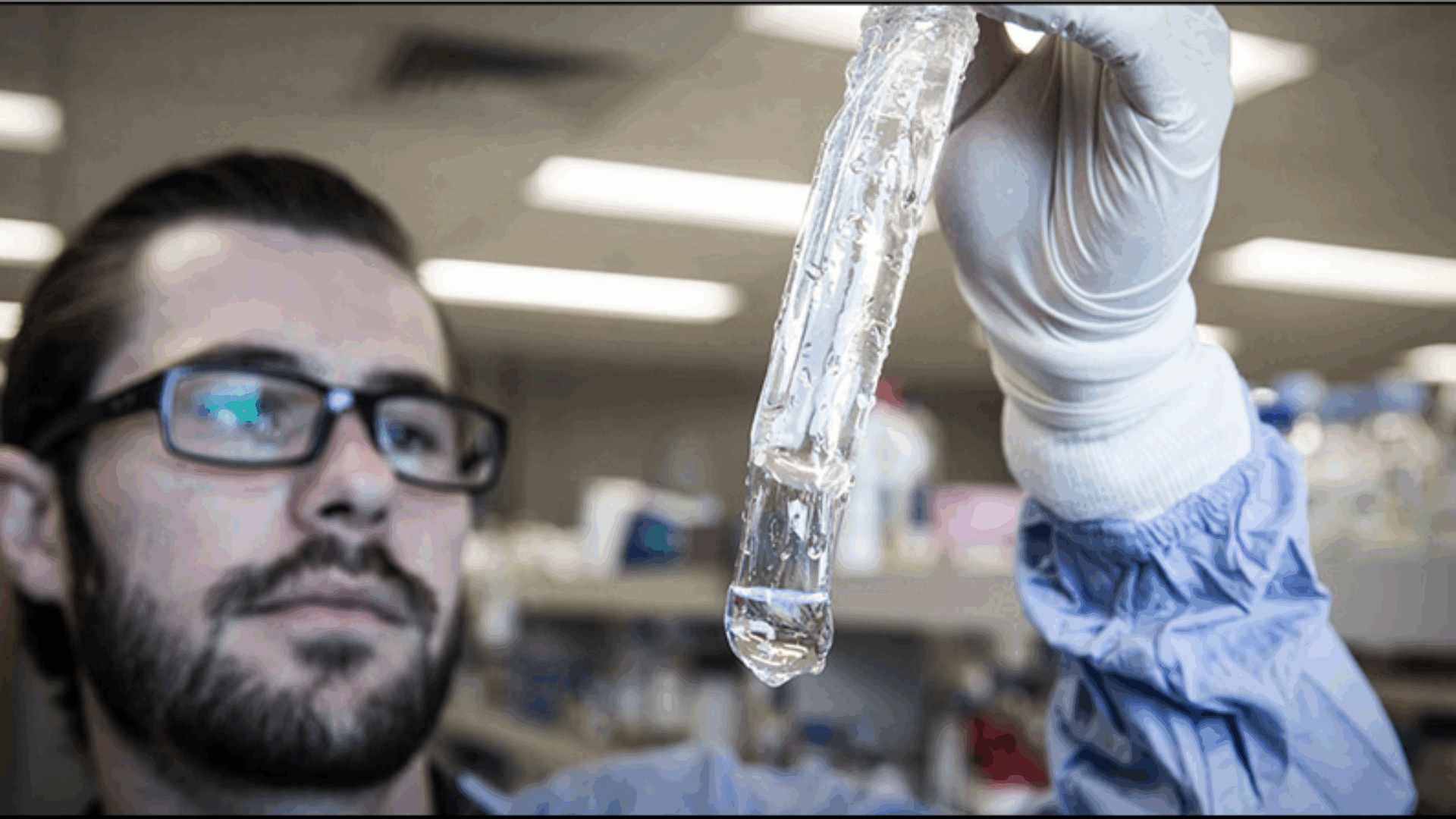
Condoms are effective both as a contraceptive and for preventing sexually transmitted infections (STIs) – but only if they are used, and there remains resistance to doing so. Condom avoidance results in more than 120 million unintended pregnancies and more than 365 million STI cases each year[1],[2].
Eudaemon Technologies was founded in 2018 with the aim of disrupting the US$11 billion market[3] in condoms by using a proprietary platform technology to develop a world-first, superior-feeling condom made from tissue-like materials called tough hydrogels.
This innovative hydrogel condom has the potential to overcome fundamental issues with current condoms, like feel, allergies, odours and tastes while saving healthcare agencies millions of dollars.
“In the past we have approached condom manufacture as just putting a raincoat on, as opposed to wearing a cashmere sweater,” Nick Northcott, the Executive Chairman of Eudaemon Technologies, said.
“What we’re now producing is something that feels like skin and has a better outcome for women’s health. If you can make the experience better for both partners, then you are increasing the likelihood that condoms will be used.”
CTCM Support Boosts Commercialisation Efforts
Eudaemon was awarded $1.5 million funding from MTPConnect’s Clinical Translation and Commercialisation Medtech (CTCM) Program to further develop their innovative solution. This support helped Eudaemon on its path to commercialise the condom through completion of a pilot clinical trial in 2023, a key step for regulatory approval.
“This CTCM project helped us show strong and compelling evidence of our product’s potential and demonstrated the benefits, features and performance for the consumer in real life in a clinical trial,” said Mr Northcott.
The project objectives included achieving manufacturing readiness of prototypes using Eudaemon’s proprietary systems, ensuring pre-clinical verification of devices to ISO standards, and executing the Phase 1 trial.
Pilot Clinical Trial Overcomes Hurdles
The Phase 1 trial faced several challenges, some specific to Australia, primarily due to a limited number of providers capable of conducting specialised condom product trials.
“This led to a slower process compared to markets like the US and Europe, where more established networks for condom product testing creates smoother pathways,” the company reported.
Recruiting participants for a condom-related clinical trial also proved more difficult than anticipated. Specific inclusion criteria, such as requiring couples who had regularly used condoms in the past 12 months, combined with other contraception methods, significantly narrowed the recruitment pool.
“The challenge was balancing recruitment timelines against the risk of cost and time overruns. We adapted by slightly expanding the inclusion criteria to include couples with partners just outside the initial age range, allowing us to complete recruitment in a timely manner,” the company said.
Cofounder Professor Robert Gorkin, Eudeamon’s Executive Director of Innovation says the project is at the cutting edge of medical device innovation.
“Condoms are unique, serving as both medical devices and fast-moving consumer goods, and rarely seeing major innovation. Completing our Phase 1 clinical trial marks one of the most significant advancements in condom materials in decades.
Disruptor Mindset
The trial has also taken the company closer to meeting the challenge of disrupting an established consumer market dominated by a few major brands, as well as an underserved public health sector.
Introducing a new product in this global market poses a risk, as resistance could arise not only from consumers accustomed to existing products, but also from retailers and distributors who prioritise established brands. Throughout the process, the company has addressed concerns by conducting thorough stakeholder consultations to understand user wants, needs, and expectations.
“We collected and analysed feedback to guide the design and specifications of our product. This iterative process was crucial in refining our technology, ensuring the condom met the highest standards of user satisfaction and performance,” the company reported.
The evidence gathered in the clinical trial and deep investigation into scaled manufacturing risks, coupled with ongoing discussions with industry experts, has given Eudaemon the confidence to move forward into the next stage of commercialisation.
“It’s been a great outcome for the business that we have proven that our product has passed through that pilot clinical trial,” Mr Northcott said. “We’ve got really strong signals around the response of the consumer and preference for our product. From a marketing point of view, having that strong consumer signal is really valuable.”
Scaling Manufacturing
Through the CTCM program, Eudaemon established some key relationships including a notable collaboration with Bosch, enhancing its technical concepts, particularly in scaled manufacturing systems.
The relationship was initiated through an event in Melbourne organised by MTPConnect, where members of the Eudaemon team toured Bosch’s manufacturing solutions facility (BAMS) in Clayton. It has led to a series of projects focused on reviewing manufacturing processes and assessing the company’s readiness for scaling up to the next level of plant design.
“Robust discussions with Bosch senior engineers helped refine our understanding of the necessary technical requirements and business strategies for scaling production, which is essential for the next stage of commercialisation,” the company said.
The company has now created a comprehensive plan for scaled Industry 4.0 manufacturing, which will also strengthen Australia’s manufacturing ecosystem.
This plan includes final design, commissioning, verification, and validation of a scaled manufacturing plant, which can produce condoms for their upcoming pivotal clinical trial involving more than 200 couples and 1,000 uses.
“It’s great that we can manufacture our condoms, and we can make them at small scale, but we’ve got to manufacture at huge scale. That’s been another part of this project, thinking about what does that pathway look like and how do we execute to take the risk out of scale manufacturing,“ Mr Northcott said.
Collaborations Drive Success
During the project, Eudaemon also leveraged CSIRO’s decades of expertise in advanced materials characterisation of medical polymers. Their insights deepened the understanding of critical material properties, ensuring medical-grade suitability. This collaboration reinforced the confidence in the material platform, supporting both ongoing innovation and a long-term scaled manufacturing strategy.
Another partnership that Eudaemon gained through the program is with the Medical Technology Association of Australia (MTAA), of which it is now a member.
As a CTCM Program partner, MTAA was on hand to provide valuable guidance and support for the project’s progress and to address any emerging issues promptly. The company described it as “a significant factor in the project’s success and our overall business objectives.”
The CTCM project also helped to strengthen the company’s intellectual property position with patent approval in over 48 jurisdictions, including a recent milestone in China – enhancing its global commercial position and providing strong protection across key markets.
Throughout the project, Eudaemon developed, identified, and documented substantial new patentable IP across its technologies including materials, manufacturing processes, product features, and quality control.
This new IP holds direct value for the new condom product and indirect value for other medical and wellness devices, forming the basis for new products to be added to the company’s portfolio.
Next Steps to Pivotal Trial and Funding Raise
The company’s next steps are to advance towards the final stages of commercialising its technology, while developing and refining its Quality Management System (QMS) to ensure that the product meets the necessary regulatory standards.
“We are just in the process of closing a funding round and preparing manufacturing for the final pivotal clinical trial. After that, we’ll be able to submit for regulatory approval to different regulators around the world to launch our product on the market,” Mr Northcott said.
The company is seeking new collaborators and partners who can bring additional expertise and resources and welcomes interest from those who share its vision and are eager to contribute to the future development of this pioneering technology.
Cofounder and Eudaemon’s Executive Director Operations Dr Simon Cook summed up the company’s journey through the CTCM Program, which is an initiative of the Medical Research Future Fund.
“The technology we’ve developed will have a profound impact on the world, by improving the accessibility and performance of sexual health products, and this grant has played a vital role in turning that vision into reality.”
[1] https://www.who.int/news-room/fact-sheets/detail/condoms