Peripheral arterial disease or PAD is often described as a ‘silent killer’ and is a common vascular complication of diabetes and cardiovascular disease (CVD). PAD affects more than 230 million people globally, and people living with diabetes are at a higher risk of developing PAD than the general population with a more than two-fold higher prevalence[1].
PAD is caused by the blockage or narrowing of arteries that carry blood to the limbs from the heart. However, more than half of all people with PAD experience only mild limb pain or no symptoms at all, until the condition is in the advanced stages.
By then, there is a dramatically increased risk of heart attack and stroke, and it is often necessary to amputate limbs. In diabetes, PAD more often affects the arteries of the lower limbs.
There are more than 4,400 amputations every year in Australia as a result of diabetes[2]. Due to the generally under-recognised prevalence of PAD and other complications of diabetes that can also lead to amputations, it is difficult to determine exactly what proportion of these amputations are due to PAD.
According to the Australian Institute of Health and Welfare, there is no national data on the number of Australians living with PAD, it is estimated to affect up to 10 per cent of all people in primary care settings[3]
and costs the national healthcare system more than $1 billion in surgical costs each year[4].
Despite its widespread and deadly incidence, treatment for PAD remains limited. The current standard practice involves the insertion of drug-eluting stents or balloons which expand to mechanically open the blocked vessel. These then release cytotoxic drugs, commonly paclitaxel, better known as a chemotherapy drug, to keep the vessel open. Paclitaxel can suppress scarring and keep vessels open, however, the treatment has limited efficacy and significant off-target effects such as killing surrounding healthy tissue.
In addition to the toxicity of the drug, the device itself commonly fails as vessels re-narrow.
Developing an alternative approach to address the underlying drivers of PAD
At the University of Sydney, a team led by Professor Steven Wise has spent the past eight years working to develop an alternative approach, the first to address the underlying drivers of PAD, and one that could provide a safe and lasting solution free of the devastating toxicity of chemotherapy.
The team’s injectable nanotherapy uses a specialised balloon catheter to deliver a natural, bioactive compound that simultaneously addresses inflammation and promotes healing.
The treatment delivers extremely precise targeting of local immune cells – or macrophages – and rapidly switches them to an anti-inflammatory, pro-healing state that prevents further scarring and plaque build-up.
Critically, it also does not require a permanent implant.
Through the inaugural round of the Targeted Translation Research Accelerator (TTRA) Research Projects opportunity, the project was awarded $739,128 in 2021 along with support from TTRA Partners, the Medical Device Partnering Program (MDPP)[5] and UniQuest[6].
The TTRA funding injection enabled Professor Wise’s team to establish a start-up company, Nanomedx, to take its work out of the academic lab – where its therapeutic potential had been demonstrated in in vitro
and small animal models – and into the ‘real world’ of pre-clinical trials.
TTRA funding facilitated critical safety and efficacy milestones for the project
Professor Wise said the company may not have been formed without the support of this TTRA funding and would not have completed these critical safety and efficacy milestones so quickly.
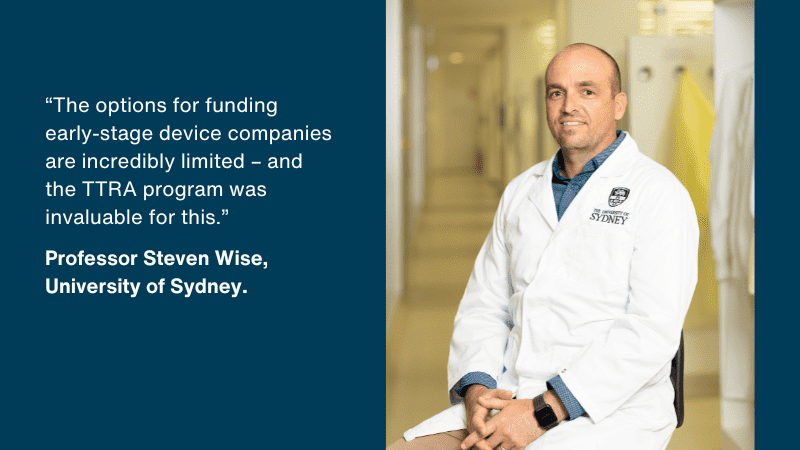
“The options for funding early-stage device companies are incredibly limited – and the TTRA program was invaluable for this,” said Professor Wise.
With the founding of Nanomedx, the team was able to focus on testing its therapy in large animal models to demonstrate safety and efficacy and to position the company and project optimally for further investment.
The first steps funded by the TTRA investment included increasing the reproducibility of the therapeutic and finalising a prototype of the balloon delivery system with design partners, Endoluminal Sciences. The team was then able to focus on designing a second-generation device that would be more appropriate for large animal models.
Through pre-clinical trials, the team showed for the first time that its nanoparticles could be rapidly cleared from rats through their livers and had no detrimental effect on sheep – even at high doses.
Validating the earlier studies demonstrating efficacy in rodent models, they also found that the therapy promoted rapid healing and reduced inflammation in the sheep model – a key study needed to attract further investment.
During the TTRA project, two patents were awarded in multiple jurisdictions including Australia, China, Japan, India, Brazil and the US.
Over the course of the project, the team also grew its network with local cardiologists working at the Royal Prince Alfred Hospital and across Sydney Local Health District, where researchers were able to observe procedures and improve their knowledge of standards of care – which in turn helped improve subsequent iterations of its catheter device.
“Our treatment has been developed in close consultation with clinicians from Sydney Local Health District, including cardiologist Professor Martin Ng and vascular surgeon Dr David Robinson,” said Professor Wise.
“We have also engaged with several US-based clinicians and device innovators, whose advice further shaped our approach. Direct feedback on our first balloon iteration was critical in determining the refinements made for the second-generation device.
“Our discussions with industry, investors and clinicians give us confidence that there is a strong desire for an effective alternative to paclitaxel-eluting devices,” he said.
Praise for TTRA partners – MDPP and Uniquest
Professor Wise also praised the input from TTRA partners MDPP and UniQuest.
“Support from these partners has been invaluable to the project from our first meeting. They have been integrally involved in the development of the overall strategy, progression of the experimental plan, reporting, wider contacts and networking.
“The TTRA partners are a critical important value-add that has really shaped the project,” he said.
Nanomedx CEO Ashish Mitra said the technology is much further down the path to commercialisation thanks to the funding from the TTRA program.
“I’m so grateful for the support of the TTRA project funding, which fast-tracked the formation of Nanomedx and accelerated our commercialisation journey,” said Mr Mitra.
CFO Richard Tan added, “The next challenge is finding appropriate investment partners to take with us to clinical trials – this will determine the trajectory of the next few years.”
Meanwhile, Professor Wise is energised about what the future holds.
“I’m really excited about our pre-clinical trial outcomes, which are showing striking results via a unique mechanism of action. I believe this could be a real game-changer for people suffering from PAD.
“Having completed all the pre-clinical safety, efficacy and production milestones, we are now well placed to move the technology toward first-in-human trials. Nanomedx is now engaging with investors both in Australia and the US to raise the next round of capital required for these trials,” said Professor Wise.
[1] Soyoye DO, Abiodun OO, Ikem RT, Kolawole BA, Akintomide AO. Diabetes and peripheral artery disease: A review. World J Diabetes. 2021 Jun 15;12(6):827-838. doi: 10.4239/wjd.v12.i6.827. PMID: 34168731; PMCID: PMC8192257.
[2] https://www.diabetesaustralia.com.au/facts-and-figures/#:~:text=There%20are%20more%20than%204%2C400,as%20a%20result%20of%20diabetes.
[3] https://www.aihw.gov.au/report…
[4] https://www1.racgp.org.au/ajgp…
[5] The TTRA program has partnered with specialist organisations to provide translation advice and support to awarded projects. MDPP provides specialist medical device support.
[6] The TTRA program has partnered with specialist organisations to provide translation advice and support to awarded projects. UniQuest provides specialist therapeutic support and is the commercialisation company of the University of Queensland.
https://www.mtpconnect.org.au/Image?Action=View&Image_id=6619