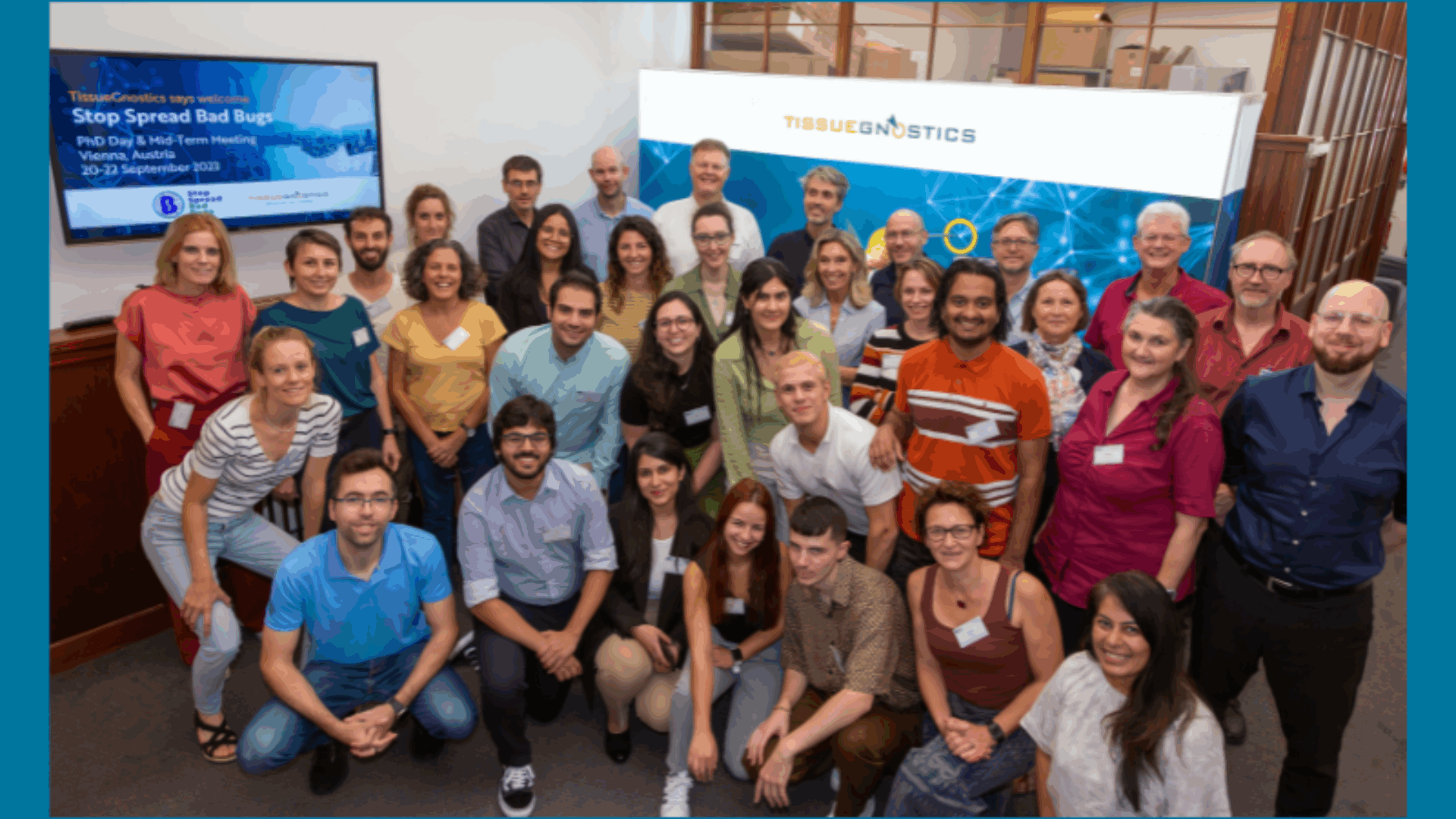
Established in 2003, TissueGnostics has substantial expertise in the design and development of microscope-based scanning hardware for imaging and artificial intelligence (AI) solutions for tissue analysis in situ. Until recently, it lacked experience in molecular biology and the workflows used in ‘wet labs’, where testing and analyses are performed using samples, chemicals and liquids.
Award-winning group leader with deep knowledge
The REDI Fellowship with Professor Batra brought in expertise in cell staining and clinical workflows that helped the company to develop knowledge of working with reagents – substances used in laboratory and diagnostic tests – and ultimately to define and develop a new staining kit for detection of multiple cancer markers on a single tissue section.
TissueGnostics had previously encountered challenges in working with antibody staining kits for multiplexing and during the Fellowship new protocols were established that overcame obstacles and led to successful kit development.
Professor Batra is an award-winning group leader in the Centre for Genomics and Personalised Health at Queensland University of Technology (QUT). She has deep knowledge of the complex genetic factors involved in hereditary disorders and uses bioinformatics tools and computational analysis as well as experimental approaches in her research. Her current research goal is to pioneer the development of improved biomarkers for early cancer detection.
During her Fellowship with TissueGnostics, she spent two six-month immersions at the company’s Austrian headquarters, with six months back at QUT in between these periods. As well as sharing her proficiency in genetics and wet lab workflows, she provided user feedback on new hardware under development and on software displaying data for biomarker analysis in cancer research.
Exposure to industry standards and career development
TissueGnostics’ Senior Product Manager, Dr Felicitas Mungenast, said Professor Batra provided invaluable feedback on TissueGnostics’ brand-new software, TissueFAXS Suite 8.0 and its latest cytometer COLUBRIS.
“Both of these are now ready for market and will be launched at this the 2024 annual meeting of the European Association of Cancer Research (EACR) in June, Europe’s leading cancer research conference,” Dr Mungenast said.
TissueGnostics’ CEO Dr Rupert Ecker said, “Jyotsna also helped with the definition of our new multiplexing staining kit, which is progressing well. She remains involved in this beyond the end of her Fellowship and we expect the product to launch in 2025.”
At TissueGnostics, Professor Batra worked within an ISO 13485 environment – an international quality control standard covering the entire life cycle of a medical device from development to production, installation and servicing – much different to her academic research environment.
This exposure to industry standards strengthened her industry specific abilities and has helped in her career development.
Professor Batra says before the REDI Fellowship program, her skill sets were primarily centred around her academic expertise in molecular biology and cancer research.
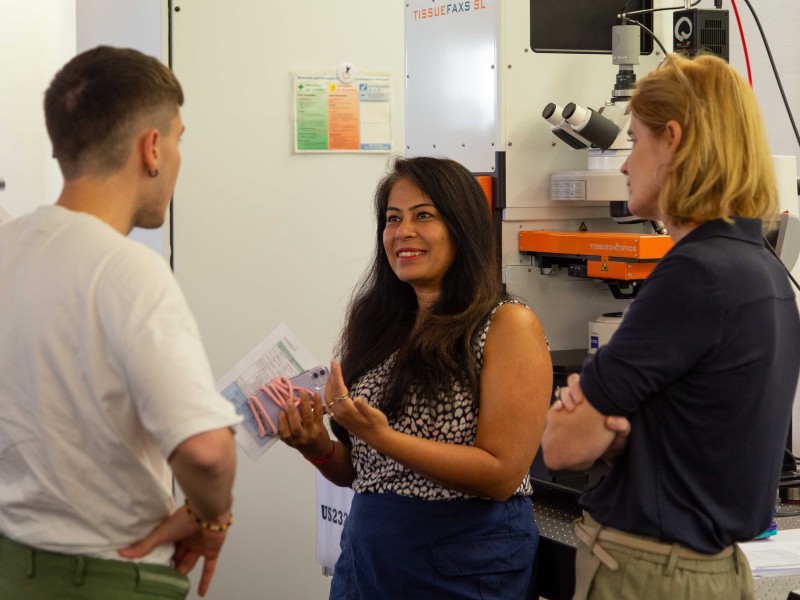
Professor Jyotsna Batra, centre, working with colleagues at TissueGnostics headquarters based in Vienna, Austria.
Significant personal growth and tangible project outcomes
“I possessed a strong foundation in experimental design, laboratory techniques and data analysis, but my exposure to industry-specific practices and technologies was limited.
“While working with TissueGnostics, I experienced significant professional growth which led to tangible project outcomes and valuable skill enhancements, particularly in artificial intelligence and quality management, as well as enhancing my proficiency in TissueGnostics’ cutting-edge technologies,” Professor Batra said.
The company had previously collaborated with academics and research institutes on scientific analysis solutions and algorithms, and research groups around the world have published data using products and data-analysis solutions provided by TissueGnostics. However, this was the first time that a collaboration project focused on the development of a multiplexing reagent kit, which not only opens a whole new business field for the company but also allows laboratories to access more streamlined and intertwined applications – from sample staining to publication-ready data.
TissueGnostics opens an Australian subsidiary in Brisbane
This knowledge sharing produced results beyond the company’s original expectations and TissueGnostics decided to open a permanent Australian subsidiary in Brisbane, creating new job positions in Australia.
Dr Ecker said the company was extremely impressed with Professor Batra’s Australian research.
“This ultimately led to us making the decision to establish an Australian subsidiary of TissueGnostics in Brisbane, Queensland, and we also started a collaboration with the Queensland University of Technology and academics there,” Dr Ecker said.
The Fellowship ended up surprising Professor Batra, too. She was promoted to full professor during her period working at TissueGnostics, which she said is a testament to the recognition of her contributions within both the academic and professional spheres.
A myriad of benefits and a long-term collaboration
“In summary, the embedded REDI Fellowship brought forth a myriad of benefits for me – from technological advancements and collaborative research initiatives to enhanced marketing and academic recognition. The knowledge and skills gained during this Fellowship contribute to TissueGnostics’ continued success as an industry leader in tissue cytometry and histopathological diagnostics,” Professor Batra concluded.
A long-term collaboration between TissueGnostics and Professor Batra extending beyond the timeframe and scope of this initial REDI project has already been initiated; three joint publications have been achieved, and she has been invited to join a European Consortium in an EU-funded Marie-Curie Doctoral Network, exploring methods for eradication of cancer relapse by targeting cancer stem cells. The REDI Fellowship experience has also contributed to advancing Professor Batra’s plans to commercialise her prostate cancer biomarker identified in her QUT laboratory.
https://www.mtpconnect.org.au/Image?Action=View&Image_id=6601