Established in 2021, with support from the Medical Research Future Fund (MRFF), the program’s unique accelerator model designed and delivered by MTPConnect aims to get technologies to patients quicker with the focus on enabling early-stage clinical trials, providing wrap-around support and deep technical and commercial expertise, all with a view to encouraging company growth.
The impact is outlined in the report Driving Australian Medtech Innovation Success, which was released today to coincide with MTPConnect’s Accelerator Showcase in Melbourne celebrating homegrown innovations and opened by the Minister for Health, Ageing and Disability the Hon Mark Butler MP.
MTPConnect CEO Stuart Dignam said the highly successful CTCM program has de-risked projects for private investment, enabled clinical trials, created jobs, and injected much needed funding into Australia’s medtech sector while advancing groundbreaking ideas into viable medical technologies to help shape the future of healthcare.
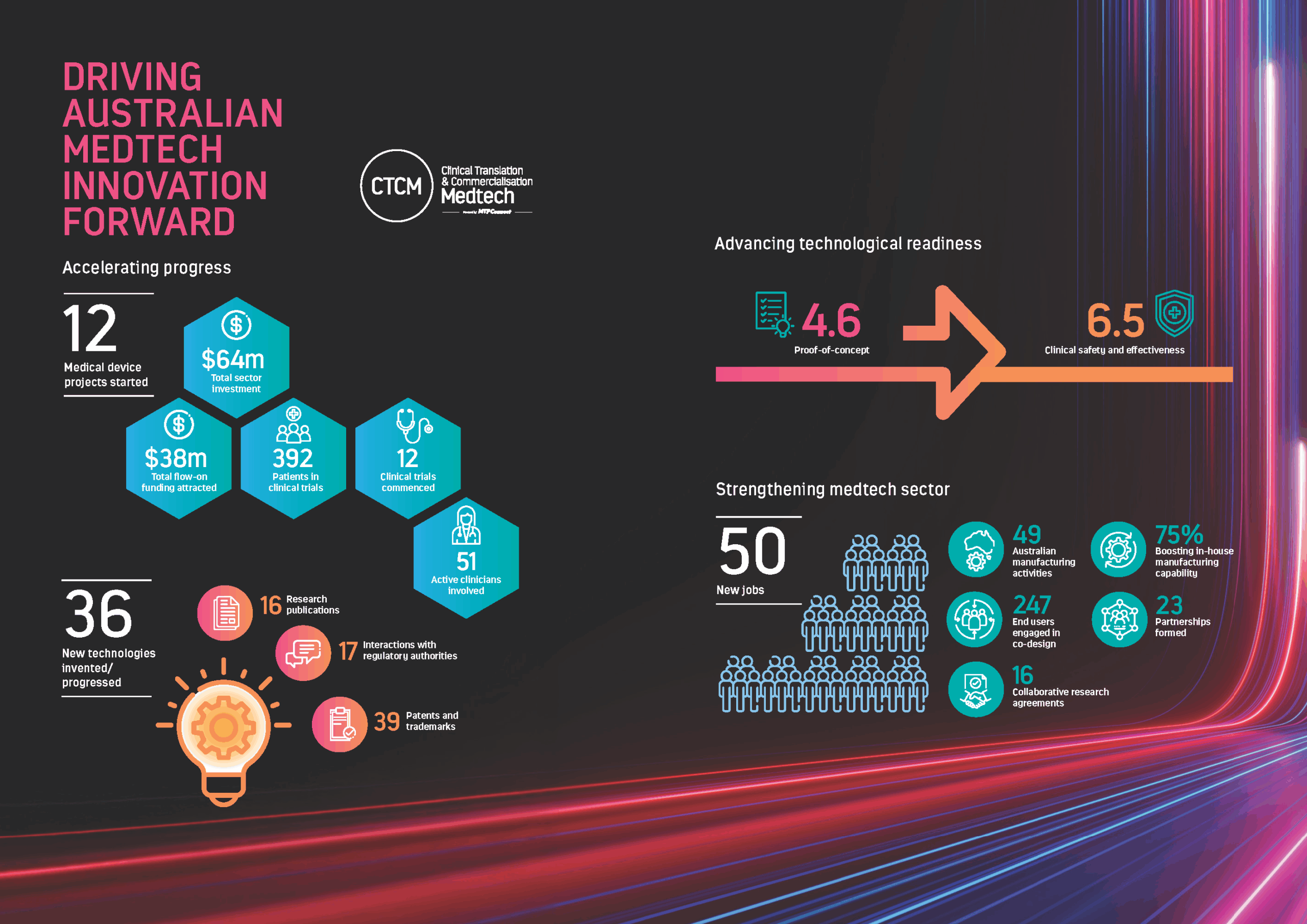
“Through this $19.75 million program, $64 million has been injected into Australia’s medtech sector and there is more to come.
“Companies supported through our CTCM accelerator have captured the interest of investors, with 75 per cent securing further flow-on and external investment, to take their innovations closer to market.
“And with its focus on commercial outcomes, the program has supported companies to take 36 new medical technologies invented or progressed towards commercialisation, ink 16 collaborative research agreements, form 23 partnerships, and engage in 49 manufacturing activities locally. One technology has even received US regulatory approval to enter the US market.
“It has been an immense achievement to see these companies conducting trials using new technology, with patient voice at the heart of these innovations, engaging 247 end users in co-design, involving 51 clinicians and almost 400 patients in clinical trials in Australia and internationally.
“MTPConnect is proud to play a role in helping these medtech projects to thrive and more broadly strengthen Australia’s ability to translate world-class science into investable and scalable medtech companies,” Mr Dignam said.
CTCM-supported projects spanned a broad range of therapeutic areas and technology types including vision, respiratory disease, cardiovascular disease, orthopaedics, neonatal care, obstetrics, oncology, infectious diseases, and preventive sexual health. The innovations in development include diagnostic, monitoring, imaging, wearables, implanted and therapeutic medical devices, used in hospital environments, safe pharmaceutical production and in the home.
Notable achievements to date include:
4DMedical received FDA 510(k) approval for its CT:VQ ventilation analysis software, paving the way for approval of their lung perfusion analysis software supported by the CTCM program. The company has also partnered with Philips to install their XVD lung scanner in government-funded hospitals across the US, collaborating towards improving veteran lung health.
ARIA Research conducted its pilot clinical trial meeting the primary safety endpoint of their non-invasive bionic vision system and have been awarded a $2 million NSW Medical Device Fund grant to further develop their device for the blind community.
CathRx recently published results of its first-in-human study for its new dual function catheter to diagnose and treat Atrial Fibrillation and signed a new distribution partner agreement for their diagnostic cardiac catheters with a Korean distributor, with high interest in distributing their new catheter once approved by regulators.
Clever Culture Systems strategically pivoted their microbiology plate reading technology towards the pharmaceutical manufacturing market and launched a new AI module for pharmaceutical environmental monitoring developed in the CTCM program, celebrating major contract sales and partnerships with major companies such as Pfizer, AstraZeneca, Bristol Myers Squibb and NovoNordisk. The company has raised $4.5 million capital to support future commercialisation efforts in the pharmaceutical market.
Eudaemon Technologies successfully completed its clinical trial demonstrating the safety of its novel hydrogel condom in humans and have progressed their manufacturing and scaling plan.
Navi Medical Technologies completed a pilot clinical trial for its breakthrough catheter tip location device, and recently received an FDA 510(k) approval, paving the way for their groundbreaking technology to enter the US market.
OncoRes Medical completed a multi-site pilot clinical trial for their QME imaging system for breast cancer detection and completed their dossier in preparation for TGA submission, attracting a $2.5 million CUREator+ grant to conduct a pivotal clinical trial.
Ventora Medical has taken its world-first airway pressure monitor for critically ill neonates through clinical feasibility and useability studies, and recently partnered with AusHealth Ventures to support their ongoing clinical study at the Royal Women’s Hospital.
VitalTrace commenced a first-in-foetus clinical study for its DelivAssure continuous lactate sensor to monitor foetal distress during labour. Building on the 2022 FDA Breakthrough Device designation, the company has undertaken discussions with the FDA to refine its clinical evidence and validation plans, strengthening the pathway toward regulatory approval. The company was awarded a WA FHRI Innovative Solutions – Precision Health grant for $500,000 to further develop the device.
VividWhite completed recruitment for the pivotal clinical trial of its glaucoma implant, with findings expected to guide the company’s future regulatory submissions.
The CTCM program provided funding up to $1.5 million per project as a non-dilutive investment, allowing companies to retain equity and ownership and support future growth projects. The program provided invaluable wraparound support to get results, including mentoring and commercialisation support from expert MTPConnect staff and program partners – Cicada Innovations, Medical Device Partnering Program, Medical Technology Association of Australia, TIA and The BridgeTech Program.